
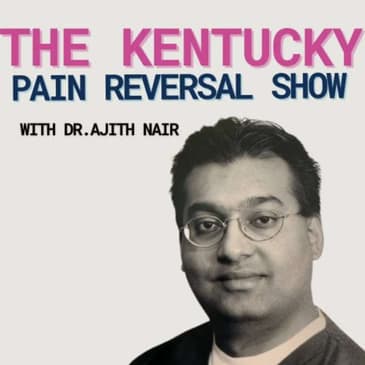
Welcome back to the Kentucky Pain Reversal Show! In today’s episode, we dive into one of the most innovative and medication-free advances in pain management: spinal cord stimulation. Building on our previous conversation about intrathecal pain pumps, we sit down with Dr. Ajith Nair to explore how spinal cord stimulators offer hope and relief for patients struggling with chronic pain. Discover how this technology interrupts pain signals, the conditions it’s best suited for, and how it stacks up against medications, injections, and surgery. Plus, Dr. Nair shares insights on the trial process, patient experiences, and the ethical landscape of pain treatment in America. If you or a loved one are seeking alternatives to pills and procedures, this episode could offer the answers you’ve been searching for.
00:00 How spinal cord stimulators work
05:37 Nerve stimulation for pain relief
08:22 Spinal cord stimulation benefits
12:23 Considering alternative pain management options
14:30 Spinal cord stimulator function
17:21 Addressing phantom limb pain
22:09 Managing Chronic Pain with Stimulators
25:47 Insurance influence on pain treatments
29:54 Challenges in Pain Management Clinics
31:12 Improving patients' quality of life
Transforming Chronic Pain Care: How Spinal Cord Stimulation Is Changing Lives
Welcome back to "The Kentucky Pain Reversal Show." In our latest episode, Jamie sits down with Dr. Ajith Nair to demystify a rapidly evolving tool in pain management: spinal cord stimulation. If you or a loved one have struggled with chronic pain, especially after surgeries, injuries, or neuropathic conditions, these insights could open a new world of possibilities.
What Is Spinal Cord Stimulation?
Many chronic pain treatments rely on medication, but spinal cord stimulation (SCS) offers something different. “00:01:30" data-type="link">The spinal cord stimulator provides electrical stimulation to interrupt the pain pathways,” explains Dr. Ajith Nair. Imagine the pain signals as a pass being thrown down the field in a football game—normally, these signals travel from your toe (or another pain location), up the nerves and spinal cord, and finally reach the brain, where they’re experienced as pain. With SCS, an electrical impulse diverts the pain signal, preventing it from reaching the brain. As a result, what might once have been felt as sharp pain is experienced instead as a tingling, vibratory sensation.
How Does the Procedure Work?
The SCS procedure involves the placement of electrodes into the epidural space—the area just behind the spinal cord. Dr. Ajith Nair assures listeners that, though the idea sounds delicate, “for practitioners that have done it for a long period of time, it is a very safe procedure,” especially when guided by imaging tools like fluoroscopy.
But what about making sure it’s right for the patient? One standout advantage of SCS is the mandatory trial period. Rather than implanting anything permanently right away, the electrodes are kept external for a day or two to see how well the therapy works. If a patient shows improvement, the permanent system can be implanted in a subsequent, minor procedure. This trial period removes the giant leap of faith required by so many other treatments.
Who Can Benefit?
SCS is especially well-suited for those with limb-originating pain—think sciatica, diabetic neuropathy, phantom limb pain after amputation, crush injuries, or a challenging condition called complex regional pain syndrome. “00:08:53" data-type="link">One of my first patients ... literally went from 10 out of 10 pain to 1 out of 10,” recalls Dr. Ajith Nair of a case involving diabetic neuropathy. The adjustability of the device is also a game-changer: patients can control the strength, pattern, or even turn it off and on as needed using a simple programmer ([00:15:05]).
Comparing SCS to Traditional Treatments
Why not just stick to pills or injections? Dr. Ajith Nair tackles this question head-on, pointing out that repeated use of pain pills often fails to bring patients meaningful relief—instead causing dependence without improving life. Persistent use also builds tolerance, making future treatment more complex. On the other hand, while injections can bring temporary relief (like epidurals for sciatica), the effects rarely last long, and overuse can have risks like steroid-induced osteoporosis.
As for surgery, “00:11:06" data-type="link">spinal cord stimulator treatment for sciatica ... may have better long-term treatment results ... as opposed to having back surgery,” Dr. Ajith Nair highlights, especially for patients with post-surgical scar tissue.
When Is a Pain Pump Preferable?
Dr. Ajith Nair offers a candid look behind the scenes of pain management: While the ratio of SCS to pain pumps in most practices is about three-to-one, in his it’s ten-to-one in favor of pain pumps. Why? Patients who have relied on high-dose narcotics for years typically need a different approach—a pain pump, which delivers tiny doses of medication directly to the spine, often fits better.
The Heart of Pain Reversal: Empowerment & Ethics
Dr. Ajith Nair champions a vision where chronic pain care is “not just something to suppress, but something that we can actually interrupt and reframe within the nervous system”. He urges patients to demand options beyond just pills and surgery and believes in candid education so each individual can advocate for the quality of life they deserve.
The episode closes by reminding us all: the practice of medicine should be about doing what is right for patients—empowering them, educating them, and giving them hope.
If you’re seeking life after pain, these cutting-edge therapies and honest conversations may offer the breakthrough you’ve been waiting for.
Podcast Website - https://thekentuckypainreversal.com/
Dr. Ajith Nair Clinic - https://kentuckianapainspecialists.com/
Media Partner - https://tophealth.care/